
From Nepal to Lithuania: What to Buy at the Most Colorful Ethno-Bazaar in Kyrchyn?
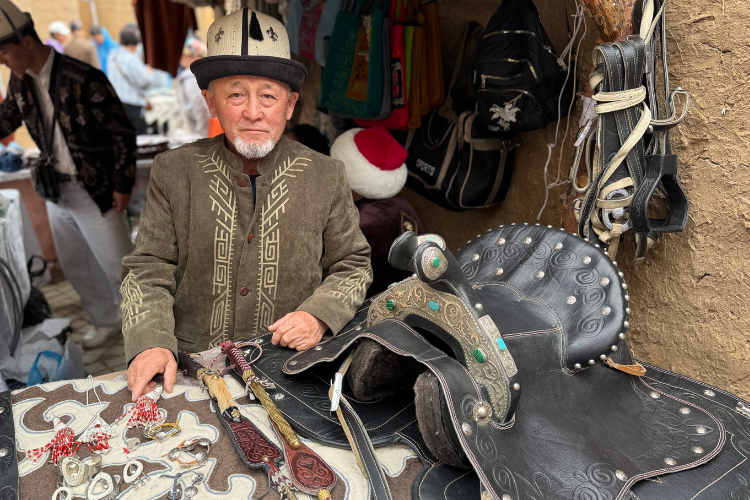
Kyrchyn Gorge is buzzing with life right now. Right next to the venues of the “World Nomad Kitchen” festival, a vibrant ethno-bazaar has come to life. While food is being cooked over open fires and traditional games are taking place in the fields, the MBANK team headed to the very “heart” of the fair. We found items you won’t find in an ordinary store — behind every piece is the story of its maker, their country, and their family.
Here are some of our most interesting finds.
Kyrgyzstan: A Saddle Worth the Price of a Horse
We’ll start with the most impressive exhibit — the traditional ornate “Ak Kangky” saddle. The third-generation craftsman makes everything himself, from the poplar wood base to the intricate stonework.
“For centuries, the price has been the same: you would give a horse in exchange for a saddle. If a good horse costs 250,000 soms today, the saddle costs the same. It takes one to two months to make — it’s meticulous work. Every pattern and every stone — turquoise, malachite — is engraved by hand,” the craftsman explains.
Kazakhstan: Royal Headdresses
Craftswoman Beibitgul brought luxurious saukele headdresses from Kazakhstan. These are her original creations that look like museum pieces.
“I come up with the designs myself; there is nothing else like them anywhere. I’ve been doing this for 20 years, but every year I create something new. The price ranges from 14,000 to 16,000 soms,” she says.
Uzbekistan: From Mathematics to Design
At the Uzbekistan stand, we were surprised by the craftsman’s story: he used to be a mathematics teacher, but his love for craftsmanship won out. Today, he has his own workshops and stores in Tashkent.
“We make large bags from bull leather, and use leftover wool to make patchwork rugs. We can make any size to order. I’ve been in this business for 18 years!” the craftsman says.
Azerbaijan: A Museum in Your Home
Artist Sadykh Suleymanzade brought miniatures to Kyrchyn. They are exact copies of paintings whose originals are kept in museums around the world.
“I want Azerbaijani art to be closer to people. So that you can not only see it in museums, but also hang it in your own home. The works cost between $250 and $300,” the artist says.
Lithuania: Light with a Story
Guests from Lithuania brought cozy lampshades. The secret is in the fabric — vintage textiles woven by their ancestors many years ago.
“We recycle old fabrics and turn them into modern designer pieces. It’s about sustainability and preserving memories. A lampshade costs 5,000 soms. You can even join a workshop and make one yourself,” the craftspeople invite visitors.
Kyrgyzstan: Lamps Made from the Heart of the Wood
Continuing our journey through the world of lighting, we met a craftsman from Bishkek who turns ordinary pieces of wood into futuristic lamps.
“This is my hobby; I work on it in my free time outside my main job. I find the wood myself, process it, and create these unique lamps. The price depends on the size and complexity — from 2,500 to 5,000 soms,” the craftsman says.
India: Metallic Chic
Unusual clutches have arrived in Kyrchyn from India. They are not made of fabric or leather, but handcrafted from metal. The design is traditional to the state of Rajasthan.
“It’s something special; we make everything by hand. A small clutch costs around 1,500 soms, while a large one costs 2,800,” a guest explains in English.
Nepal: A “Health” Bracelet
Craftsman Prabhat from Nepal brought jewelry that, according to beliefs in his homeland, is believed to benefit the body.
“This bracelet is made of copper, brass, and zinc. Copper kills bacteria, while zinc helps the body strengthen its immune system. These are our ancient healing traditions,” he explains.
Kyrgyzstan: 60 Hours for One Bag
We finish our tour at the Kyrgyzstan stand, featuring unique felt travel bags. The craftswoman designed the patterns and developed the production technique herself, combining felt and leather.
“I’m the first person in Kyrgyzstan to make models like these; I taught myself everything. One bag takes an entire week of work, eight hours a day. That’s about 60 hours of handmade work! The bag costs 20,000 soms, but it will last for years,” the craftswoman says.
There is an enormous selection at the ethno-bazaar — you’ll want to take everything home at once. To save you from having to search for ATMs or carry cash in the mountains, the general sponsor, MBANK, has provided a convenient payment system. With MPay, you can pay for any purchase even where there is no internet connection at all.
Come to Kyrchyn for unforgettable experiences and take a piece of world culture home with you!